


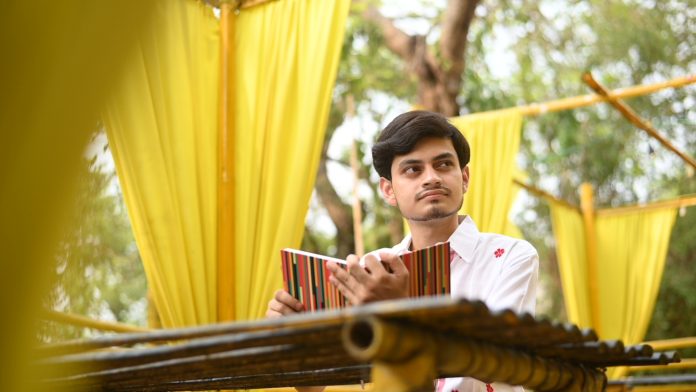
Directed by Siddhartha Saha | Reviewed
by Debopam Deb Roy
Bakshobondi is a short LGBTQ film from Tripura, written and
directed by Siddhartha Saha. The film is produced by Pinky
Banik and was completed in December, 2021. The core concept
of the film revolves around how society treats people of the
same sex who are in love with each other. In a typical
society where people are expected to get married to  someone
of the opposite gender, same sex marriage is often seen as a
sacrilegious act. Bakshobondi not only narrates the tale of
two lovelorn men, but questions marriage as an institution
as well. The cinematography and editing of the film as done
by Prasenjit Debnath and Nabhojyoti Bharati respectively, is
quite commendable. The screenplay is done by Manish Sinha
whereas Subhrajit Nandy composed the background score for
the film. The film is dedicated to all those who do not get
closure in their love life and whose voices remain unheard
because of our existing societal norms and practices. The
Bengali term Bakshobondi literally translates to the state
of being boxed, or stuffed in a box like compartment. A lot
of people from the LGBTQ community suffer much in the same
way, where they have to hide their true identity or swallow
their feelings for someone of the same gender.
The story of Bakshobondi features Joydip Bhattacharjee as
“Neel”, a young poet and writer who is homosexual by birth.
Since his childhood, Neel is forced to keep his natural
identity hidden from his family and as a result, he learns
to hide away a number of things inside a trunk which include
his favourite doll, a coronet, some bangles and other items
related to a typical wedding ritual. As he grows up, Neel
meets with “Subho” (Surya Paul), a boy from his college who
eventually becomes his love interest. Neel and Subho become
good friends and in a few days’ time, their newfound
friendship turns into a romantic relationship.  However,
Subho’s mother, being a stereotypical orthodox woman,
becomes skeptical about the recent development in his life
and hence, she decides to get him married off to a girl of
her choice without taking his consent. Maithili (Rituparna
Bhattacharjee), now Subho’s wife, tries to come close to her
husband but is shoved aside every single time. This strange
behaviour from Subho rouses doubt deep in her heart and in a
matter of few days’ time, she discovers Subho’s personal
diary where he had disclosed all his feelings for Neel.
 The
use of close-up shots to establish the mise-en-scene is
truly credible. Through different shots and camera angles,
the spatial elements have been constructed in a fairly
subtle manner. The use of tableau shots to establish purely
dramatic scenes is worth the mention. Certain scenes which
are either dream sequences or contain a monologue, are very
poetic. Moreover, the use of Rabindra sangeet to elevate
emotional sequences is definitely worth the mention. Every
song sung by Tanumoy Biswas did justice to the visuals that
appeared on screen, thus evoking nothing but absolute
melancholia within the audience. Apart from the vivid images
on screen, the use of background music deserves credit. For
example, the scene where young Neel locks away his favourite
playthings in a trunk, the use of arpeggios over minor
chords indefinitely heightens Neel’s repressed feelings even
though not a word is said by the narrator to support the
on-screen image. Secondly, the scene where Subho’s mother
coincidentally discovers Neel and her son on the rooftop, a
very short ominous track layered over the scene coupled with
shot-reverse shot tells us about his mother’s perspective.
The use of monologues and other conversational dialogues can
also be seen as a crucial aspect that drives the narrative
forward.
 Gay
love is an extremely sensitive issue in a country like
India, or at least, it has been even till the last couple of
years. Considering how patriarchy has heavily influenced
society since it’s inception, most people find it hard to
normalize a homosexual relationship. As a result, millions
of people either suppress their inner desires and suffer
silently for the rest of their lives or take their own lives
as they find it an easier way out to cope with the pain of
forceful separation from their loved ones. Separation is a
complex matter that is not just restricted to a homosexual
relationship. When a person is forced to marry somebody from
the opposite gender, it is not just the man who suffers
alone. It is also disturbing and painful for their
significant life partner as he/she is deprived of the
minimum attention that they seek from their respective
other. In due process of “curing” the “sickness”, every
third person suffers equally, if not any less.
 Debopam
Deb Roy graduated from Jadavpur University with
Film Studies. He is currently working as a
Blogger/Reviewer/Unit production manager in Kolkata.

