


Interviewed by Barry John Terblanche
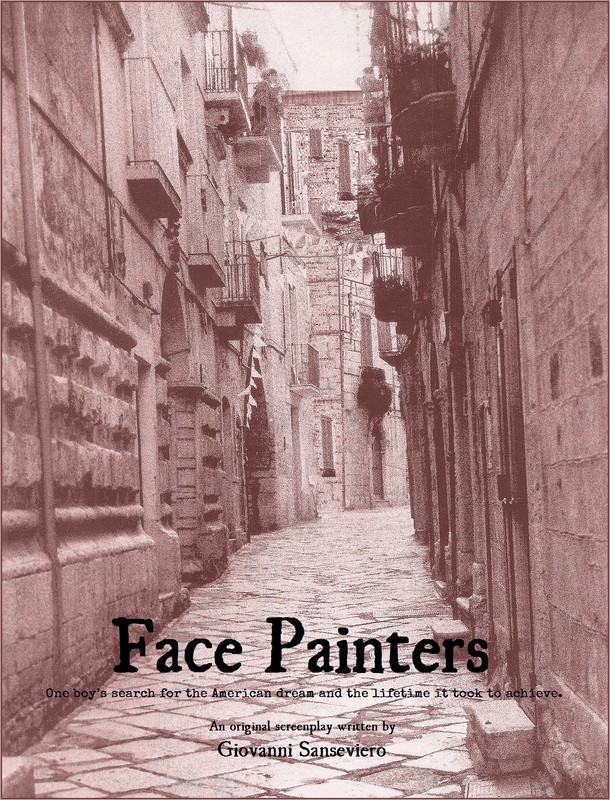
Face Painters is a dual-narrative, multicultural epic set primarily in two eras in the lives of the Gravetti family. Told through the eyes of Buono Gravetti, the present time is 1963. Then, serving as an epilogue to Buono’s ninety-nine-year journey on earth, our time with him will conclude in 2022. The past narrative is 1928, a retelling of Buono’s recollection, as a six-year-old, weeks before immigrating to the United States.
Cult Critic – Your name, it’s Italian; your story pivots around the Italian–American immigration. Is Face Painters based on your past family history?
Giovanni – Not so much on the nose,
but the “emigration” aspect of Face Painters was part of my
family’s evolution to the United States. I guess, like
anyone permanently leaving their homeland for a better life
elsewhere, my parents were already being bombarded with the
scary thoughts of not knowing what to expect, and then the
actual hard realities of many times being treated like shit,
for lack of a better word, the second-class “shackles” the
locals would put on them.
The funny thing was, from some of the stories my parents
told me, many of the people that did treat them unfairly,
were their own kind, fellow Italians: “The ones that got
here before us and could barely piece together an English
sentence, suddenly, they were so superior to us.”
I don’t know. Maybe beating up on your own kind is easier,
more cowardly for sure, like a mafia mindset taking
advantage of their own kind. Or maybe these superior idiots
simply didn’t like being reminded of just how much they were
once treated like second class citizens themselves.
Face Painters touches on many examples of being
treated unfairly, and by all inequities, not just racism:
from within one’s own ethnicity (the former narrative, 1928
Tuscany) to the civil unrest perpetrated against African
Americans (the latter narrative, 1963 Brooklyn) Even the
protagonist’s brother will spew venomous words towards his
own family, and you should see what a “pillar of community”
he is not.
Cult Critic – Have you envisioned any actors to portray the colorful characters in Face Painter yet?
Giovanni – Mark Ruffalo (twice
suggested to me) to play Buono, the elder, illiterate son
(1963), and the character Face Painters completely
revolves around (no idea who would portray Buono as a child,
but think loveable Toto from Cinema Paradiso); Bobby
Cannavale to play Luca, the overreaching father (1928) and
failing elder (1963), the deuteragonist in our story and, no
lie, suggested to me on four different, unsolicited,
occasions; Vincent Piazza to play Michael, the younger
turbulent brother (1963); Stanley Tucci to take on Leo, the
hard- nosed patriarch (1928); Benicio Del Toro to cameo
Garibaldi, a poetic shipping mogul (1928); Mark Margolis to
play Fatman Providenza, a callous local strongarm (1928);
Marion Cotillard to play Isabella, Buono’s loving and
unwavering mother (1928); Shiri Appleby to portray Abbey,
Buono’s love-torn companion (1963). Not sure who would
portray feisty Scarlett, her tomboy daughter, but think
Scout from To Kill a Mockingbird; John Amos to play Freddie,
a downtrodden father (1963); Jon Hamm to play Elias, a suave
Wall Street investor (1963); Juliette Lewis to play drunkard
Molly, Michael’s “Teddy Girl” squeeze (1963), and Bill Camp
to take on Bishop Pio, a trickster cleric (1928).
As for directing, a few names obviously come to mind, and an
actor’s director would be paramount. I don’t know why, but
over the past few years, and as unusual as Daniel Day-Lewis
may seem for a director’s choice, I keep thinking…why
not? What he represents as a disciple and practitioner of
cinematic storytelling, in general, tops my list as a person
possessing the consummate sensibilities for a sweeping epic
like Face Painters.
Cult Critic – Would you want to be a part of the filming… director or producer? And what emphasis would you concentrate on the most to best bring out your story?
Giovanni – Well, it’s not like I would even have a choice. This is a big-budget project that will require some heavy hitters— from directing to talent to investors, so an opportunity like you’re suggesting isn’t even plausible; essentially, I have completed my job. However, what I can continue to offer, invaluably, is my insight to the characters, their mindset, and the overarching psychology of Face Painters. Mind you, not that anyone would even care for this input, but this is a heavily-concentrated character study above all else, and the utmost care should to be secured in preserving this specific quality. And when money, and budgeting, and all the logistical damnations to a production start conflicting (nothing new here), if preserving this very personal quality is emphasized most, as you asked, Face Painters will succeed as a timeless testament to cinematic storytelling…I’ll bet my life on it.
Cult Critic – Why the title; Face Painters?
Giovanni – In the former narrative of 1928 Italy, our hero, Buono, reminisces about his childhood before journeying to America, and a great deal of this has to do with his father, Luca, and his ambitions to one day be an American style funeral director. When Luca blindly attempts such a funeral in a little agrarian town—complete with never-before-seen makeshift makeup, fancy casket, and a chapel filled with meaningless pomp, the peasants show their disdain by calling him a face painter. Subsequently, when Buono follows in his father’s footsteps in the latter narrative of 1963 Brooklyn, the epithet lives on, but now in its plural form.
Cult Critic – What would you like the audience to take away from the story/movie.
Giovanni – Forever knowing Buono at a very personal level and as if he was always a friend of theirs. And even if they didn’t know him, that he still somehow knew them; through his own hardships and what he had to endure, his understanding of their hard times through his willingness to not give up on himself. Maybe in the end, the audience somehow realizing that they always did know Buono through the mutual understanding of the gift of life, and to not give up on it. I guess a cathartic experience is what I’m laboring to say.
Cult Critic – Your writing to your voice is very strong on drama. Is drama your forte? What other genres interest you, and why?
Giovanni – I’m a sucker for drama; my parents were opera singers, and growing up for my siblings and me was like being in one big outlandish opera. Even when my father yelled at me—I was a real ballbreaker—he took on this high C quality that really had a pleasant ring to it. But let me tell you, when things did get bad, there was no shortage of front-row drama. But what I enjoy writing most are the dark comedies, that thin line between humor and tragedy that can really be screwed around with. I have something brewing along this demented line.
Cult Critic – For a 197-page script, how long did it take to write, and how many drafts?
Giovanni – At least fifteen years of
stop and go. Many times, I simply put the script down and
walked away for months because I didn’t know what the story
was about—sounds strange not to know that, but sometimes you
suddenly find yourself frighteningly deserted on some island
after confidently thinking you knew everything. And then,
there you are, Gilligan, sucking on a coconut. Scary feeling
to be there after investing so much time.
As for drafts, I’d say two dozen mostly dealt with
formatting; working the dialogue’s appropriate slang, idioms
and the references that could be made during the two
different (period) eras; and cleaning up the action
paragraphs—the grammar of it all I’m a complete mess with.
But I did stick with it.
On a heavier scale, I’d say at least three dozen more drafts
interspersed that panned out to be major overhauls, like the
overall plots and toying with the many threads, placing
exposition; rebuilding the protagonist and his troublesome
brother; who would live, who died, and so on. But a real
tricky thing was toying with a double narrative; it really
messed with the logistics of scenes and their
timelines—especially with the main characters being depicted
at two different stages in their lives. It was a juggling
act to say the least, and with continuity always being
paramount.
Cult Critic – What were the biggest challenges you faced in writing this script?
Giovanni – Simply sitting down and
writing at a consistent level. This is a problem with
anything I try to write, although other than complete
meltdowns, I did stay with the script in one form or
another: editing, writing backstories, picking characters
and arbitrarily starting fights between them, even writing
scenes that didn’t apply to the story—let’s see what they’re
capable of saying or doing, then finding their boundaries
and how they might treat each other. Just peeling apart the
layers of the characters really opened things up for me,
discovering them more and more. Then the dialogue and the
mannerisms became first nature to the individuals—to the
individuals, not me. Many, many times, it was more like
taking dictation and not at all writing dialogue.
Later on, the biggest challenge was not being intimidated by
the size of the story, especially a sweeping double
narrative that I never tried before. And for sure, the
stories had to be unique but still ring familiar to each
other.

Cult Critic – Most screenwriters would not venture 197 pages. They’d shy at 140+. To this, what advice would you give aspiring screenwriters?
Giovanni – I’m not sure. Maybe
sticking to an industry standard page count would be wiser
at first. Get a couple of those under your belt, and then
work your way up to a more complex saga if that’s in fact
what you want to write. But I’m a little nervous about
applying rules to storytelling. Just write the story and
don’t meander, keep it sharp. And what actually is an
industry standard? Coppola made a dynasty out of
three-hour-plus screenplays, so I would have loved to watch
some jaded hack tell him what the industry standard should
have been. You know what the industry standard should be?
Write a terrific story, then the page count can be dealt
with afterwards.
After all, would the page count even matter if the story
didn’t?
Cult Critic – You have put great effort into marketing your script, rightfully so. It even has its own dedicated website. What is your advice on marketing one’s script?
Giovanni – I really can’t answer this
without repeating the same things we’ve already heard over
and over: from finding representation to your work achieving
some notoriety on those screenplay platforms, ultimately,
the more the better, I think. And research the rep. for the
best pairing up. Blind queries and that “one size fits all”
gameplan won’t be efficient; at least it never was for
me.
Two things for sure and in this exact order: #1: if you’re
on the cusp of marketing, you better make damn sure your
work is unimpeachable. Don’t bullshit yourself because a
second chance is the only thing even more remote than a
first chance. You can’t give that first chance away. Stay
home, forget your friends, whatever you have to do to hammer
out the best work you can. Then market to the appropriate
people which will have a higher ROI (Return On Investment).
And #2: don’t ever rely on anyone else to do your
work—certainly not at this point. Got yourself a manager, an
agent? Great. Now start looking for the leads yourself and
work together with them. I assure you, you won’t be their
number one concern; you on the other hand, by default, are
already your most important client.
Cult Critic – What drove you to become a screenwriter?
Giovanni – My lack of success as an actor…but all kidding aside…my lack of success as an actor.
Cult Critic – What’s next for you… are you working on a new script?
Giovanni – I’m trying to get back to a
dark comedy themed around mutual betrayal between two
charlatans and the greedy players around them. It’s really
out there as for the story’s reality which experiments with
just how thinly apart sound reasoning is from outright
absurdity…maybe all-in-all, this reality’s not so far
out there by the looks of things that are happening around
us. It’s got the Coen Brothers, John Malkovich, and John
Ruffalo written all over it. As for right now, I have to
keep pushing Face Painters the most. The festival
circuit alone has been quite an undertaking for some time
now, with just about 160 competition entries to date and
pushing sixty awards. Plus, all the website updating,
artwork, spread sheets, social media, interviews and so
on.
This is all necessary for the next step which is to
hopefully get the script to the actors I have in mind; this
is something I have to try, especially with a screenplay
that is so adverse to the three-act beat sheet. If I’m lucky
enough to gain their interest, I believe their influence
will go a long way to help navigate that proverbial long
road ahead of me. I’m confident the festival accomplishments
will speak well on my behalf—at best, a pleasant icebreaker
it should prove. Frankly, for the moment it’s really all I
have to work with, so ever up and onward!
Thank you, kindly, Barry John Terblanche. Great
questions, and I really appreciated it.
With respect, a hat tip.
Gio

